Wednesday, August 15, 2012

Newborns in Cloth series, pt. 3: Putting your perfect stash together!

Last week, we interrupted the Newborns in Cloth series for a little World Breastfeeding Week break (and, boy, are we glad we did! The overwhelmingly enthusiastic response has left us feeling so very grateful to be part of such a positive, supportive community of readers!), but this week, it's time to cough up the real goods: the promised series culmination, the "newborn stash layout" post.

Per Part One, the idea behind a newborn stash is to have enough diapers to actually fit your tiny newborn that will also (1) allow you to wash diapers only once a day, (2) be easy on you and whomever else might offer to change a diaper while you're adjusting to life with your new bundle, and (3) save you money over what you'd have spent on disposable diapering your newborn.

So let's lay out the perfect newborn stash checklist!

(First: I recommend having 26 diaper changes. I know that sounds excessive, but hear me out: I tallied up my newborn daughter's diaper changes during her first couple weeks of life, and one day she got up to 22 changes in 24 hours. Those four extra changes were all I had left while the 22 she had dirtied were washing and drying! 26 was the perfect number to have on-hand.)

8 FuzziBunz OS Elites or SoftBums Omnis (or four of each if you're a sampler).

James models a SoftBums Omni.
These aren't just part of your newborn stash--they will remain in your baby's cloth diaper stash for years to come. In the case of SoftBums, your little one will surely wear them until potty-training--the shell can "grow" that big! But they both truly, truly size down small enough for a newborn to wear with no leaks--and they are decently trim, at that!

Brand new Zeke in a FBOS.

When you purchase SoftBums shells, you will also need to purchase the newborn-sized "mini-pods" to use as the absorbent core inside them, and you can choose to stuff the pocket or purchase eight pods and four shells. The FuzziBunz Elite comes standard with two minky inserts, and one of those is newborn-sized.


12 cotton prefolds and your choice of 5 covers.

Prefolds: Tried. True. Inexpensive. Classic.
Can you say, "Inexpensive, tried and true?" This will make up the bulk of the stash of diapers you use at home and will really stretch your budget and ensure you have enough diaper changes for a newborn. Don't let the 'fold' part of the world prefold intimidate you--I covered how simple they are to use in Part Two. Many moms who are initially turned off by the plainness of prefolds end up listing them among their favorite diapering systems.

So, covers? I cannot recommend the Thirsties Duo Wrap enough. It's tiny when it's snapped all the way down, and a trim fit is guaranteed. If you decide you like prefolds enough to continue using them after the newborn stage, these covers will last you until your baby is 18 lbs. and, unlike if you're using the admittedly adorable Thirsties XS cover, you don't have to worry about your baby outgrowing it before she fits into her 'main stash' of cloth diapers. 

Typically, you'll need one cover for every three diaper changes, unless you get an explosive poop and can't reuse a cover that 'should' still be in rotation--that's why I always recommend that fifth back-up cover. (Go ahead, pick the print! You know you want to.)

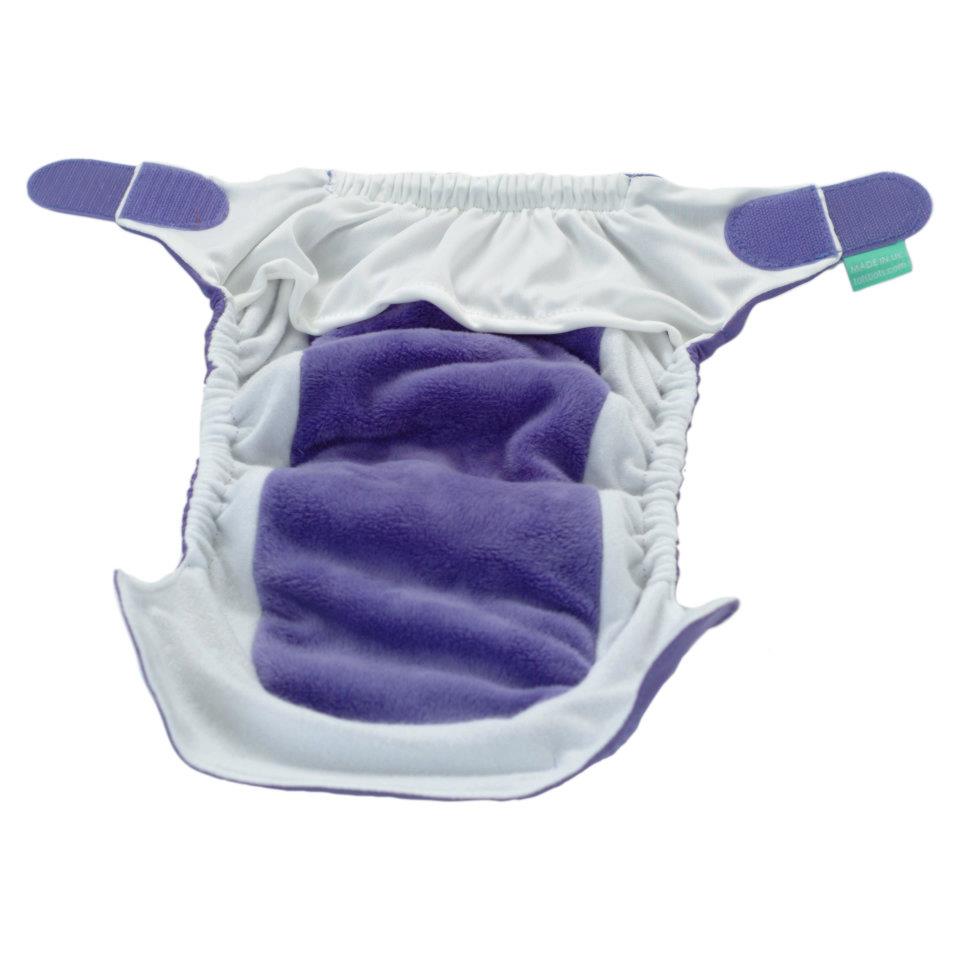
2 Tots Bots Tini Fit All-in-Ones.

This is your 'church nursery' or your 'Hallelujah! Someone else wants to take this round!' diaper. With the strongest hook-and-loop material you've ever seen, a beautiful color palette to choose from, and a luxuriously soft minky inner, you can be assured that not only will your stand-in believe that cloth is easy--she'll also believe that cloth is wonderful.

So why only two? At nearly $19/pop, this one doesn't take you far on your long-term savings journey because it is so small and will only fit for so long. While I believe that the materials that make up this diaper are well worth the price-point, my ultimate goal is to build a stash that costs less money than using disposable diapers during the tiny stage would.

 4 FuzziBunz XS pocket diapers.

This is your 'diaper bag' diaper. At only $13.95 per diaper, this is an excellently priced, excellently rated pocket that gives you all the ease of disposable diapers. The fit is smooth and incredibly trim, so your baby's adorable outfits--the ones you know you save for errands--will fit just like they should. And the stay-dry inner layer means that if changing 'IUW' ('immediately upon wetting') is not a logistical possibility, your baby's skin will still feel dry.


So what is a 'dream stash'?

A 'dream newborn stash' combines all the best things about today's cloth diapers and applies them to the newborn stage: (1) money-savings over disposables, (2) cuteness and a trim fit under clothes when necessary, and (3) equal ease-of-use to disposables when convenience takes precedence.
 
What MY 'dream newborn stash' budget looks like all laid out:


The goodmama diapers blog estimates in this hilariously accurate breakdown that it costs $336.84 to disposable diaper a baby for the first eight weeks. So with the above 'dream newborn stash,' you've definitely saved your money--especially because you won't be buying disposable wipes, either, since you've already prepared your 'main stash' with cloth wipes. And I'd estimate that most of these, even the ones designed to fit newborns, will fit most babies until they're closer to 10 weeks old.


There are, of course, ways to cut the cost further, like replacing those last six convenience diapers with more prefolds and a cover, replacing my beloved Tini Fits with two more FuzziBunz XS, or just having a bigger 'overlap stash,' dealing with that little bit of bulk, and supplementing those with prefolds and covers to get your full 26 changes in. 

Now some of you may ask, "If prefolds are so easy, why bother with the more expensive diapers at all?" The answer is that I want my 'dream stash' to include some diapers that my friends and family members could have no problems changing--some that could go into the wet bag wholesale as they come off, without my having to explain, "Oh, no, I wanted to reuse that cover later!"

Others of you may ask, "Why not just have a whole stash of one-size diapers that get really tiny? Why not just 26 of those?" And the answer is: why not! If that's what you want, then definitely do it. But: many moms find that they don't need any more than 15-18 diapers once their babies are older and void their bladders less frequently. In order to stretch your dollar even further, we always outline the 'buy only as much as you'll need of the fancy diapers, then supplement with prefolds for the newborn stage' plan.

Does this look a plan you could hang with? Let us know in the comments how you did the newborn-in-cloth thing!


Wednesday, August 8, 2012

This is what it's like to breastfeed in a changing Southwest Louisiana in 2012.


The tide is turning toward breastfeeding in Louisiana.

This has been in the works on the national scene for a while. There are government-funded “Breast is Best” campaigns throughout the US and “Breastfeeding welcomed” signs on storefront windows in major cities. The news media regularly covers women’s legal right to nurse anywhere, at any time in 43 states. We’re all aware of NYC Mayor Bloomberg’s controversial Latch On campaign, his take on the World Health Organization’s Baby-Friendly Hospital Initiative.
National and local governments have taken an interest in breastfeeding as a means of disease-prevention (because, I suspect, spending public advertising dollars encouraging women to breastfeed is easier and less controversial than tackling the public health crises caused by the food industry). There’s a now-twenty-years-old World Breastfeeding Week celebration (that’s Aug. 1 – 7), and August is National Breastfeeding Awareness Month.

And it should be mentioned that increasing numbers of mothers are plugged into Internet communities and in-person, locally organized social groups who gather to discuss topics related to mothering. Breastfeeding, like modern cloth diapers, sleep schedules, babywearing, and homemade purees vs. jarred food vs. babyled weaning, is bound to come up.

So I have to tell you, I don’t breastfeed because it will make my baby smarter, or healthier, or closer to me than she would be if she were fed with an alternative milk and nipple. Study after study, campaign after campaign tries to tell me this, but I have a hard time processing the comparisons. I’m really not convinced that those are the most appropriate reasons upon which to found a campaign for breastfeeding—or that the dominant media conversation should be one that centers on breastfeeding versus bottle-feeding. I don’t breastfeed because it’s ‘best’ or ‘better than’ formula-feeding… or because of anything related to formula (which is, despite some of the discourse you’ll find bandied about in ‘crunchy mom’ subcultures, real food that a baby can survive and thrive on, whether it is given as a maternal preference or out of circumstantial necessity) at all.

I breastfeed because it’s normal.
 
I mean it. And there’s a certain amount of privilege and luck behind that statement, I’ll admit it. I was set up for success by forces beyond my own control. I have had access to this idea that humans are mammals, and mammals nurse their young, for as long as I can remember: I was breastfed in the mid-‘80s by my working mother. My husband was breastfed by his mother, a homemaker who had seven children between 1976 and 1987 and wasn’t socially acquainted with anybody else in Lake Charles, La., who nursed. I watched my cousins being breastfed as I was growing up; I watched my sister-in-law struggle some through her nonetheless eventually successful first breastfeeding experience during my first pregnancy. I watched my sister pump milk for her premature triplets (well, okay, I didn’t watch, but I knew she was doing it). I was a part of those kinds of online women’s communities before I was ever pregnant. I had natural births, one of them at home, which is proven to make the nursing relationship easier to establish. And I stayed home with my first baby; I brought my second to both of my part-time jobs with me until she turned one.
I can’t imagine knowing how to be a mother without making milk (although I know that many, many good mothers throughout history have accomplished just that). For the first year of my babies’ lives, nursing hasn’t been about feeding at all, really. The transmission of calories was secondary. It was just what my babies did… often. It was my mothering paradigm, my primary means of mothering, what I spent most of my days doing: it was how my babies went to sleep, how they got their nutrition, how they got the antibodies to build strong immune systems, how they were reassured when the garish lights and unfamiliar sounds (or, later, the absolutely fascinating, MOMDIDYOUSEETHAT???! scenes) of, well, anywhere that wasn’t our home sent their tiny brains into overdrive. It’s how they overcame boredom when our priest’s homily ran over seven minutes. It’s how I distracted them from the pain of shots. It’s how they went about their everyday lives as infants.

There’s a great deal of evidence that suggests that human infants instinctively exhibit attachment-promoting behaviors to ensure their own survival. Very young babies cry to nurse every thirty minutes, not because they are hungry, not because they’re not getting ‘enough,’ and not because mom’s milk is ‘too thin,’ but because they don’t know that a tiger isn’t about to eat them. When a mother is casually nursing her baby while she stands at the stove and stirs her gumbo or sits at her oak desk writing depositions, she is still, despite her nonchalance, holding him closely in fierce protection, giving him sustenance that comes from her own body—and he gets that. He gets what that means. Maybe not on the poetic level that we do, but instinctively he knows that this is right. He is a mammal baby, and this is what mammals do under biologically normal circumstances. (It’s also the mechanism by which adequate milk supply is ensured. Supply management is not much of an issue, barring certain very real but also statistically rare medical conditions on mother or baby’s parts, when the pair is lucky enough to be able to share an ‘unrestricted access to the breast’ kind of daily routine.)

The ‘breast vs. bottle’ conversation in the media and even in medical circles so often becomes about feeding, but the fact is that breastfeeding is not purely a feeding choice. It’s a lifestyle choice. It’s choosing to be attached to a baby continuously or to make other arrangements that will not compromise the milk supply. It’s choosing to possibly even allow a child to remain, both literally and metaphorically, ‘attached’ for longer than we as a culture tend to think babyhood should last, for the sake of respecting the instinctive, paleological parameters of human child development rather than the culturally imposed ones--or it can be choosing some nuanced combination thereof.

It’s choosing to adopt a mothering paradigm that hasn’t been a popular one in our culture until recently, and women sense that. It’s okay for them to reject it; people have dignity and the agency to carve their own paths. But it’s also okay for them to embrace it.

I feel less and less alone as a breastfeeding mother in Southwest Louisiana. I am witnessing more and more local success stories—more and more women who attempt to establish breastfeeding are succeeding, are nursing exclusively to 6 months and then continuing nursing with complementary solid foods until 12 months and beyond. Many are pumping at work (rock stars!) and managing their milk supply with great care, learning the science of lactation and its delicate interplay with the endocrine system so intimately that they can pinpoint where they are in their fertility cycles by how many ounces of milk they are pumping on a given day.

The tide is turning because the support is there.  Informationthe right informationis more accessible than it was even when my first child was born in early 2009. The La Leche League International chapter meetings in Lake Charles are teeming with new faces—and friendships—every month. Moms of twins, moms of preemies, moms who have more than one child but have never breastfed before, moms who work, moms who are inducing lactation for an adopted baby, moms who are in the military, moms who are women of color, these are the moms who are joining us for our monthly meetings now who weren’t joining us three years ago.

I don’t think the tide is turning because of the studies. I don’t think it’s because the medical establishment is supportive—because International Board Certified Lactation Consultants and other breastfeeding-minded medical practitioners in the United States have to fight daily against a system wherein breastfeeding is not normalized, where pregnant women are booby-trapped by their OB/Gyn practices with bags of 'free' baby product samples sponsored by formula companies before they schedule their first ultrasound.

The tide is turning because women are insisting that their biologically normal practice be recognized as a socially normal choice, and they’re having such a good time doing it that their friends are joining them.

Friends. That’s how we solve a public health crisis. Woman to woman, the way it’s always been done. And year by year, we’ll make it normal. Year by year, we’ll turn the tide.

Wednesday, August 1, 2012

Newborns in Cloth series, pt. 2: How do you fold those things, anyway?

So you're interested in cloth diapering your newborn--or at least in considering the possibility and exploring the benefits... and the logistics. Last week we discussed ways to cloth diaper your too-small-for-their-main-stash newborn in a cost-effective way. This week we'll tackle the (not really all that) hairy how-tos!
 1. Cloth diapering in the hospital: should I? How do I do it?
Cloth in the hospital? Why not?!

If you've invested in a separate stash of newborn-sized cloth diapers, you probably want to get as much use out of it as you can, and where better to test the waters of newborn cloth diapering than in the hospital, where... you just don't have much else to do? Besides, cloth diapers are a much more accurate way to measure 'output' and make sure your baby is having no trouble with feeding and digesting!

If you want to use your cloth in the hospital, include it in your birth and baby care plan. "We are a cloth diapering family! We don't expect the staff to worry about learning to use our diapers; we are happy to handle every diaper change." Make sure your husband is familiar with the system you will be using, and put him in charge of changes if possible--your only jobs are to rest and to feed your baby.

Bring your hanging pail for dirties and your cloth wipes and wipe solution if you want to use cloth wipes. Have your husband go home with dirties to wash them if your stay is extended. Having a diaper sprayer installed at home is helpful for the meconium phase, but if you're breastfeeding, once your transitional milk comes in, no spraying is necessary--breastmilk poop truly is water-soluble.

2. Prefolds: How do they work?

The 'fold' part of the word prefold can be a little intimidating. I thought the point of this modern cloth thing was that I didn't have to do this folding-and-fastening thing? Fret not! Fear not!


Because of the ease of wrap-style covers, folding a prefold is a matter of folding in thirds. For longer babies, fold 'the long way,' along the seams:

Folding 'the long way' is great for taller babies. It can also get you more use out of your prefolds as your baby grows.
For shorter or smaller babies, fold 'the wrong way,' or against the seams:

Fan out in the back for best poop-catching results.

Lay folded prefold inside a cover; change when wet! Covers that don't get poop on them can be reused throughout the day.


3. We choose to circumcise. Can we use cloth while it's healing?

You sure can! Your doctor will probably recommend you treat the surgery site with a combination of Vaseline and Bacitracin and wrap with gauze. The problem? Gauze doesn't exactly contain all those oozey meds, and you don't want anything greasy, thick, or petroleum-based on your fabric, because it isn't water-soluble, and that stuff will spread around inside of and coat your washing machine, leading you straight to Repelling City.

So what to do? I can't take credit for this brilliant idea; it comes from the Padded Tush Stats blog and was sent to me by one of our savvy clients. Put a dollop of those meds on a disposable cotton makeup round! The package of them will cost less than disposable diapers, and you'll only need them for a week or two. Your cloth will be protected, your little guy will heal beautifully, and any diaper-changer volunteer can easily follow these instructions!


4. Changing cloth diapers while out and about is so intimidating to me.

Being away from your changing table can be intimidating, no matter what kind of diapers you're using, especially if you're caring for a circumcision or cord, dealing with skin sensitivity, or worrying about getting sprayed mid-change!

The easiest way to eliminate confusion and keep things quick is to either pre-load your prefolds into covers, mimicking a one-piece system, or to use pockets or AIOs when you're out. As seldom as you're likely to be running the roads with a newborn, you should only need a handful of these pricier 'easy diapers' to get you through your errands!

An organized (and organizable!) diaper bag makes it easy to reach everything you need: changing pad, diapers, cloth wipes, wipe solution (a pre-mixed spray bottle is easiest on-the-go!), Butt Balm (if necessary), and a wet bag for storing the dirty!

As for that mid-change 'baptism' that boys like to pull out of their little bags of newborn tricks, I have a counter-attack in my arsenal that works no matter what kind of diaper you're using. Before you unfasten the wet diaper, wipe your baby's inner thighs, right at the crease, with a pre-wet wipe (or spray your wipe solution, mixed with cooling witch hazel, in the same spot). The surprising, cool wetness encourages the baby to completely void his bladder if there's anything left to spray. Wait a few seconds before changing. This also gives you the opportunity to learn what your baby's "potty face" looks like in case you are interested in practicing elimination communication. (I'm not, but many parents love it!)


5. What about the cord stump?

Keeping the cord stump clean and dry is the best way to promote it falling off in its own time. In order to keep from agitating the wound, simply situate your baby's diaper so that it doesn't touch it.


No need for special cloth diapers with notches for the cord stump! Newborn cloth diapers are cut short enough in the rise to accommodate the cord stump. Both the Thirsties XS Cover and the Thirsties Duo Wrap in Size One are cut perfectly for this purpose.

Well, voila! There you have answers to some of the most commonly asked questions about cloth diapering a newborn. If you've got more questions, please ask them on our Facebook Page! I'll turn them over to our expert consultants AND our expert clients to get feedback for you!

Wednesday, July 25, 2012

Newborns in Cloth series, pt. 1: So, you want to cloth diaper your newborn!

You've got your stash of cloth diapers and you're ready to go! You can't wait for your little bundle to arrive for many reasons, but one of those is definitely about wanting to put fluff on her bum. But, wait! Some of these look a little big for a newborn? Won't they leak? Will all her cute clothes fit over all that fabric? Hmmm...

You may have heard that many cloth diaper manufacturers are now producing newborn-sized diapers. These diapers are probably the cutest things I've ever seen. Nothing makes my heart go all pitter-patter on me when I'm pregnant like the sight of a newborn diaper next to a pair of teensy newborn socks.
Newborn diaper, newborn feet. Does it get any better?
Photo copyright Stephanie LeBlanc Photography, 2010.
Cloth diapering a newborn is an obviously smart choice. You've spent your pregnancy avoiding things that will harm your baby, with your wine glasses collecting dust on a high shelf and your midwife's or doctor's phone number on speed dial in case you have a question regarding the safety of a medication or supplement. You probably completely eliminated BPA from your home, and you were careful to register for or purchase phthalate-free feeding gear. Why start your baby's first hours off with exposure to chemicals and plastics in what is perhaps the most vulnerable time in her little body's life?

Of course, there's the cost savings factor and the 'less waste' factor--all those reasons to cloth diaper, period, apply to cloth diapering a newborn. But cost is something that does need to be looked at carefully:


It costs nearly $400 to use disposable diapers in the first 12 weeks of a baby's life. Most of us don't know that when we have our first babies: we're usually gifted enough diapers to get us through that stage and maybe even well past it, and we don't find out how expensive disposable diapers are until much later.

But the second baby? You might find yourself in the grocery checkout aisle with your spouse, your older child, and your grunting-up-something-fun 8-week old, and you find yourself hearing (or saying!), "Honey, do you remember diapers costing this much when Little So-and-So the First Baby was born?"

However, one could easily spend $400 on a separate stash of newborn-sized cloth diapers, and they might even be outgrown before the "newborn" stage officially ends at 12 weeks old.


So how do you keep it cost-effective? you're thinking, a little disappointed. Maybe we'll just stick with the disposables until he fits into the stash we already have. This just seems like a lot to think about.

Never fear! Part One of this Newborns in Cloth series will lay out a few ways to keep the cost down for you so that you save money over what you'd have spent on disposables. Part Two will discuss all the tips you'll need to know--how to fold a prefold, handle circumcision sites, and change diapers quickly while out and away from your changing table. Part Three will list each item in my ideal newborn stash, price points included, using the ideas and shopping principles outlined in the previous installments. You may find that, with this guide, cloth diapering your newborn can be cost-effective and fun!

Option One: Mix it up a little to stretch the budget


One of my favorite newborn cloth diapers, the Tots Bots Tini Fit (right), is a brilliant little diaper made of really fine materials. I mean, top-notch. This is the Grey Goose of newborn diapers. Suffice it to say that my blogger's salary isn't going to cover a whole newborn stash of these gorgeous poop-catchers, however much I swoon over them every time I walk into the Home Office.
 

(Speaking of poop: some newborns make an awful lot of it, and, boy, can they wet a diaper quickly, too. It's not uncommon for a newborn baby to require around 22 diaper changes in a day. I'm not exaggerating--believe me, I've been there. "Why's the baby fussing?" "I don't know! She just nursed for an hour-and-a-half, and then I changed her diaper five minutes ago because it was wet... (checking)... Oh. It's wet again.")

So since a newborn needs so many more changes than an older baby, the wisest way to spend your money is to mix it up--the styles in your stash, that is. The ratio will depend on your budget, but a mostly-prefolds-and-covers stash with a small handful of "easy diapers" like the Tini Fit or the FuzziBunz XS mixed in for outings will allow you to have the 28 or so diaper changes you'll need (enough to have clean ones while others are washing).
Prefolds, shown packaged above, are inexpensive (24 diaper changes comes to just under $50) and simple to use, and covers can be reused throughout the day. You'll need one for every 4-6 prefolds.

Option Two: Opt for a smaller One-Size, then supplement with newborn diapers
If you opt for your "main stash" to include One-Size diapers that truly get tiny and trim, like the FuzziBunz One-Size Elite or either of the SoftBums lines, then you only need to fill in the gaps to make sure your baby is covered when she's in that "peeing every fifteen minutes" stage. Let's say your starter stash includes 12 FuzziBunz One-Size Elites--that takes care of 12 of the diaper changes in your newborn stash, too! Twelve prefolds and three covers, plus three or four newborn-sized pockets or AIOs could round out a '28-changes' newborn stash nicely.


Option Three: Instead of 'newborn' and 'everything after,' go with the Duo system
The Thirsties Duo Size One--available as a wrap-style cover, a pocket diaper, a fitted diaper, or an all-in-one--really does get teensy-tiny, and then it grows to fit to 18 lbs. Once your little one is ready to move into a Size Two, you'll need fewer diapers. In other words, you'll spend a little more on your first stash, but when it's time to up-size, you won't be spending nearly as much.

Option Four: Plan to re-sell anyway

What if you don't want to do prefolds? What if you don't want a varied stash? What if you want 30 easy-peasy, super-trim AIOs? Well, why not! It doesn't have to cost you a fortune, because you're guaranteed a return on your investment. The re-sale market for newborn diapers is HOT, and your diapers are sure to be in great condition after only 8-12 weeks of use. Facebook is chock full of cloth diaper re-sell discussion boards, and eLeMeNO-Pee even has our own!


Option Five: Buy pre-loved

There are deals to be found (if you're willing to forgo the manufacturer's warranty)! While prefolds, which are heavy and expensive to ship, aren't worth buying pre-loved unless it's local, you can find newborn diapers at around 20% off retail by looking through re-sell forums, asking your local eLeMeNO-Pee consultant if she has a client getting ready to sell, and digging through her clearance box.

Option Six: Keep your warranty, but get your 20% off anyway
It's a little-known fact that the consultants I've come to know and love these past few years offer more than just the private consultations you've heard about! Hosting a party can pay off in big ways, including receiving a 20% discount and FREE shipping for every guest. What if you scored a newborn stash for 20% off, then resold it for 80% of the retail value after only 10 weeks of use? How's that for a smart shopper success story!


There you have it, my cloth diaper-curious friends. Newborn cloth diapering just doesn't have to be pricey! Next week, we'll cover all the FAQs and make sure you feel confident cloth diapering a newborn. Until then, let's talk!

Wednesday, July 18, 2012

All in One: More time for fun!

When I started cloth diapering in 2009, the consensus on AIOs (the cloth diapering mom code word for 'All-in-One') was that they were difficult to keep clean, took several cycles to dry on low heat or several days to dry on an indoor clothesline, and weren't worth purchasing when a pre-stuffed pocket was just as easy to put on and take off.

All-in-Ones: 'Who needs 'em?' thought I. Ha!

That seemed like solid logic to me. So I didn't bother with any AIOs for a while.

But eventually, I began to see the benefits:

1) When I didn't have any clean pocket diapers stuffed and ready to toss in the diaper bag, it was time to leave for church and then head to the in laws' house for the day, and it was all I could do to get us all out the door on time. Shoving a laundry basket in the trunk of an already stuffed-to-the-gills compact sedan and knowing I'd have to sort and fold laundry when we reached our lunch destination on a Sunday was pure penance for my poor planning on Saturday.

2) When the diapers were in the dryer or on the line, I needed to head out the door alone, and my husband was notorious for matching up a small insert and a medium pocket, so that when I actually did sit down to sort and stuff the diapers, everything was mismatched until it all got washed again. This isn't a "my incompetent husband" story, either--he's a completely competent father and, I'll admit, a better housekeeper than I am. However, laundry is kind of my domain. On that note, I probably couldn't organize his toolbox the way he likes it, you know?

3) When my kids were still young enough to want to be right.on.top.of.me, no matter what I was doing, but old enough to enjoy getting into whatever I was doing, sorting inserts by size and stacking them up in an organized fashion became a game of constant anticipating, distracting, redirecting, loudly sighing, and hunting for tall surfaces suitable for sorting that weren't yet covered in other laundry.

And, truthfully, AIOs in 2012 have essentially resolved most of the problems I encountered while reading product reviews in 2009. The constructions of our two favorite AIOs, the Thirsties Duo AIO and the Tots Bots EasyFit (as well as its newborn-sized counterpart the TiniFit), make for no trouble cleaning because of the way they're designed.

Option #1: My all-time favorite, the EasyFit (which actually has a pocket).

That's because the insert is tongue-style, meaning it has fewer layers sewn together, because they're arranged into a long strip that then creates several layers of absorbency once they're folded together. Fewer layers sewn together is more conducive to deep-down cleaning.
 
But that means you still have to stuff it, right?

Right. Well, theoretically. The surface will lay more smoothly and be easier to spray out (should that become necessary) if you do stuff the pocket with the tongue-style absorbent minky insert, but since the insert on the newest version is all-minky, it doesn't matter which side of it touches your baby's skin, and you could technically just fold it over rather than stuffing it.

But, at least for me, stuffing itself isn't my problem with pockets. It's the sorting inserts by size and THEN stuffing that takes all that time. With an attached tongue-style insert, it's just a matter of stuffing it in right before the diaper goes on!

It also dries in my dryer on low heat after one cycle. One cycle!

So what's the downside? Well, it does have a higher price-point than other cloth diapers. While that price-point is definitely reasonable considering the quality of the materials and the fact that it's produced ethically in Scotland, the price point makes it a "mini-stash for baby-sitters" diaper rather than a workhorse, "main stash" diaper for most families.

Option #2: The Thirsties Duo AIO.

Frankly, the Thirsties Duo AIO is adorable. It's also quite affordable! At just $15.75, it's a basic microfiber-based diaper with a stay-dry microfleece layer. Available in two adjustable size ranges, Size 1 and Size 2, the design is like a tunnel, so that wash water can pass completely through, from the top waistband of the diaper to the bottom one:

The only drawback? It does take two cycles on low heat to dry. It will dry a bit more quickly if, upon pulling it out of the washing machine, you turn it inside out before putting it in the dryer or on a clothesline, but turning diapers right-side in is almost as much a chore to me as stuffing pockets, so two cycles it is.

This diaper is ideal for a daycare stash. Even if you prefer to use more "complicated" cloth at home, the Duo AIO is a high-quality, low-cost option that a daycare provider simply couldn't object to. In fact, my $15.75 is on your daycare telling you they love it!

My favorite part? Both of these fabulous diapers come in your choice of snaps or hook-and-loop. We've discussed the snaps vs. hook-and-loop quandary before, and concluded that they each have their advantages. Personally, I like to have a little of each, but I will say that the durability and quality of the Tots Bots hook-and-loop material? It may as well be snaps. That stuff is sturdy.


If I could do it all over, would I forego my workhorse pockets and my beloved gDiapers and go with a stash of only AIOs?

That's a tough question to ask a diaper junkie like me. I think it's more accurate to say that, in my perfect world, I would have a day's worth of AIOs. They truly do free up some time, and I've never run into a problem getting these two options deep-down, all-the-way, squeaky, sparkling clean.

Wednesday, July 11, 2012

You know you're the parent of little kids if...

(Note: I'm never sure if these little lists are overplayed, but I kind of love them. They remind me of my elementary- and junior high-aged childhood in the mid-90s: radio deejays sampling audio of Jeff Foxworthy's "Redneck" stand-up series, the early days of e-mail forwards. That nostalgia coupled with that amused-proud-affirmed-and-eager-to-share feeling combo that comes with reading something you can relate to, something which describes your unique situation, something that makes you feel like one of the special and initiated... Well, it's a little addictive, not to mention fun to share. So I continue with the "You might be ______ if...." lists.)

Without further ado,

You Know You're the Parent of Little Kids (or One Little Kid) If...


-You've ever found yourself wearing a colorful sample from each of the food groups on the jeans you pulled out of the dryer half an hour ago.
-Your mealtime blessing should end with, "This meal was brought to the table by Crayola Color Wonder."
-You can toss a 'neat enough' ponytail into a wiggly toddler's hair in .04 seconds.
-Elmo haunts your dreams.
'Iiiiiit's Potty Time with Elmo! Ahahahahaha!'
-You have succumbed to the temptation to use the dreaded, over-priced, under-filling, ridiculously artificially flavored Pop-Tarts as a 'quiet game' reward at the grocery store, despite acknowledging to yourself that the box may as well constitute a sign on your forehead that reads "JUDGE ME" in the checkout line.
-You've finished the box of Pop-Tarts after 10 pm that same day.
-You have no qualms with telling your toddler to eat the (huge, gigantic pieces of) food that's fallen onto his shirt and into his high chair seat before serving him the requested seconds.
-You're not sure what that gunk is on your cell phone touchscreen, but your thumb makes a kind of scritch-scratch-swiiiish! sound when you scroll, and that can't be right.
You thought I was kidding?
-You've given up on that one little free spirit in your house's chances of ever wearing clothes that match.
-You have two crockpots and use them at the same time.
-You've soaked, cooked, bagged and frozen 15 single-serving bags of black beans.
-You know how to translate all of your toddler's words that end in '-eeee!" into real English and have become accustomed to flexing this muscle in front of people who may or may not really be giving you that "What's wrong with her?!" look.
Good to the last drop?
-It's 11 pm and you're making one last sweep-through in the kitchen. You discover the coffee pot; it's still on, heating that last half-centimeter-tall-layer of coffee, which you were planning, all day, to eke one last sweet, creamy cup out of. You were pretty sure you needed it, but you never got around to pouring it. You seriously consider pouring it.
-You're wearing hand-me-downs from your mother's wardrobe, circa 1996, because you upgraded to organic milk, effectively edging out the 'grown-up clothes' budget.
-Your potty-learning toddler has ever confused the basket on her tricycle with her potty chair.
-You've turned down a shopping invitation with your best girls from college. Shopping? That's when you add to your cloth diaper stash, right?
-You don't even consider going out with friends past 4 pm.
-On the rare occasion that you get a baby-sitter during bedtime, you spend your evening bragging to your childless friends about your kids' talents, looks, quirks, and potty accomplishments. Oops.
The little snowflakes' exhibit.
-You've ever had Big Plans for an 'art day' for your kids that became more of a 'scrub smushed crayons and dried tempera paint out of the carpet' day. You have no idea how the carpet became exposed underneath the Visqueen you laid out.
-Speaking of art day, your living room centerpiece is a four foot-tall, primary-colored easel. It also doubles as the childproofing barrier to your fireplace.
 -Your Netflix "Recently Watched" queue contains one Rated R action film, one rom-com from the late '90s, one unrated, straight-to-video version of a Rodgers and Hammerstein musical, and 22 episodes of Yo Gabba Gabba.
-You know that Netflix Streaming doesn't have the Jack Black episode of Yo Gabba Gabba, and this continues to disappoint you daily.
Enjoy them for ten minutes!
-You've had to plan all summer activities, camps, and traveling around potty-training.
-You've taken a picture of your perfectly polished fingernails immediately after painting them, knowing full well that this is the last time they will ever be un-smudged before you polish them again.
-Elmo.
-You know exactly what your three-year old means when he requests that you Ziploc his leftover breakfast because he doesn't want it to get "rusted from being left out."
-You have tried to write a "You might be a _____ if" list, and kept thinking of fantastic, clever zingers, but forgot them all while you were changing that diaper.
-Elmo.

Wednesday, July 4, 2012

There's freedom in going cloth!

Yup, what the title says. Cloth is freedom.

(Is this too predictable? It seemed careless to publish a new post on Independence Day and not acknowledge the whole 'freedom' motif. What good American wants to read about laundry routines or 'prefolds vs. pockets' when it's the Fourth of July? Freedom is where it's at.)

Recently a French feminist philosopher wrote a high-profile book deriding American mothering trends of the last decade, which are finally having some influence in France. In her book and in the subsequent magazine articles surrounding its release, Elisabeth Badinter criticizes the modern cloth diaper consumer movement, claiming that both cloth diapers and breastfeeding enslave women to the 'environmental cause' and to their own biology.

But by and large, cloth diapering families disagree with her assessments, at least about cloth. Cloth diapering--and going paperless in the kitchen!--provides certain freedoms that can't be gained by using the disposable alternatives. Many of these benefits and freedoms are obvious to families who have already incorporated cloth diaper laundry into their day-to-day routines, but if you're on the fence and just can't imagine how cloth can fit into your lifestyle, this little list may help tip the scales:

1) Cloth frees up money. In fact, this is probably the #1 reason that anybody chooses cloth. Even a "fancy" stash will save you considerably. Compare an $800 (very high!) estimate for an upfront investment in a large stash of "fancy" diapers to the "slow leak" effect that $2800 will have on your bank account over three years of diapering one child.

2) Cloth frees up time (and even more money). This one may have you thinking, "What?!" But it's true. Hear me out: unless you're super on-the-ball about scheduling disposable diaper deliveries (and you always remember to change your standing order when your baby moves up to the next size), you're going to be running out to the store to buy a pack of diapers from time to time.

If you're an Admirably Frugal Couponing Mom (TM), you're going to be hunting for a coupon, printing or clipping it, and trying to find a store with a sale to match it up with. Then you're going to see what other sales they're running in case you can also get a good deal on toilet paper and paper towels, so that you can make a large enough purchase to earn lots of rewards points. You pull out your coupon binder and find the appropriate coupons while the kids take turns trying to shove each other out of the car attached to the front of the buggy and the baby screeches and wriggles and claws at your chest in his sling. You stock up on all these paper goods while they're on sale, because that's smart shopping, and there goes $40. You manage to bribe the kids to stop shoving with the promise of ice cream, and you buy the sale brand neopolitan. That's another $3. You scored a pretty good deal and saved well over what you'd have paid at regular retail, but you could have spent nothing and spared the time it took to prepare for and accomplish the shopping trip.

And if you're like me and not-so-on-the-ball, you're going to be running out to Wal-mart at 9 pm, leaving a sleeping baby with your husband. You're going to be in such a hurry to get the errand done before the next feeding that you forget what coupons are altogether. You're going to remember that you haven't eaten since breakfast, when you ate your toddler's wasted toast crusts, so you pick up Subway while you're inside. You stop by another couple of aisles in the baby section and choose at least one gimicky item that you don't need because it has a cute owl on it and, frankly, you're enjoying being out by yourself for a little while. THEN you pick out a package of diapers, which you'll pay full retail price for. On your way to check out, you dig through the DVD bin for a couple $5 flicks to pop in during the upcoming six-week growth spurt. Then you toss a few potted plants into your cart. And a rump roast. And those cake donuts that were marked down in the bakery at the end of the day. Then a treadmill and running shoes. And before you know it, you've spent $400 (enough to purchase a very nice stash of cloth) at Wal-mart. How do they always do that to us?*

Cloth diapers, on the other (what is this, the third?) hand? It's just laundry. It's another household chore to put on your big kids' chore chart, another basket to live out of when life gets hectic.

3) Cloth diapers contribute to chemical-independence. This is an obvious one. If you're reading a cloth diaper blog, you probably know about some of the sketchy stuff in disposable diapers, like dioxin and the superabsorbent polymer known as sodium polyacrylate, aka "sposie beads," aka the cause of tampon-induced Toxic Shock Syndrome in the 1980s. Going chemical-free is a daunting task, but more and more families are taking it on. Cloth diapers and clean-rinsing, cloth diaper-safe laundry detergents are an obvious first step in giving the gift of a chemical-free babyhood.

4) Cloth frees up your baby's fashion options. You know what? Cloth diapers are cuter than much of the clothing available for babies. The color palettes and prints offered by the major manufacturers are fashionable and often not as "baby-ish" as your average baby bodysuit. I know I've always preferred to let my daughter's cute diaper peek out from beneath a dress rather than worrying about keeping track of bloomers, and in the summertime, both of my babies have worn a t-shirt and diaper until they were 2. Not only was it adorable, but it was a great way to introduce cloth everywhere we went!

5) Cloth frees us from landfill-dependence. Or, as one of my friends puts it, "It frees you from the guilt of having to throw crap away all the time. Literally!" Our kitchen was already paper-free when we began cloth diapering. We found that once we began, we were only having to take our trash to the road every other week! This felt nice and provided a boost of confidence. Now that we recycle and compost, we rarely have trash to contribute to a landfill. While we're not as green as some people, it feels good to be able to say we're not adding to the waste. These are the kinds of habits that we hope to impart to our children as they grow. And you know what? It wasn't that hard. It feels like we took a few baby steps, like switching to cloth diapers, and suddenly we were there!

6) Cloth frees you from diapers sooner. At least this has been the experience of many. And while we all know that my oldest (cloth diapered from six months) child waited until he was 3.5 to potty-train, my younger child, who has been in cloth diapers since the morning she was born, has been using a training potty every now and then since she was 14 months old and is acutely aware of when she is wetting, probably because she was able to connect the sensation of urinating to the feeling of wetness in her cotton prefolds even as a small baby. I plan to attempt hardcore potty-learning before her second birthday.

The American Experiment was one of independence--and also inspiration. Be inspired this Fourth to take advantage of our FREE shipping (and, yes, it can be combined with the FREE FuzziBunz deal!). Make a choice to bring your family some freedom! You won't regret it.

*This story never happened to me. Please. A treadmill?